Tuesday, March 25, 2008

KUROSAWAAA!

Stud.

I know the main focus of this class is to appreciate a film holistically. However, I still believe that some components really do make or break a movie. In this case, I'm going to wax idiotic about the decisions a director made about an actor. I'm talking about the great Kurosawa-Mifune connection. I thoroughly enjoyed every Kurosawa movie we watched (especially Yojimbo) I'm gonna go out on a limb and say that my favorite part might be Toshiro Mifune. Partially because I have a slight crush on him. (He has dreamy eyes.) Partially because he was able to portray a self-deprecating, roving warrior in one film, and a novice, consumed detective in another pretty seamlessly.


I was most impressed with Yojimbo, mainly by Kurosawa's deliberate inclusion of Mifune as the composed renegade amidst power-crazy crazies. The dynamics between the groups and Kuwabatake Sanjuro, Mifune's character, are super evident in the expressions given and the emphasis put on said expressions. Mifune's expressions are subtle, yet he delivers a broad range. Compared to the thugs, he is much more composed and rational, which is hugely evident, especially when he manages to dupe them several times in a row. He clearly dominates the screen, with his smug grimace and rhythmic walk, enhanced by the music composed by Masaru Sato.
Even the music is notable in the film, as the score almost mocks the "grave" situations in the film. Titillating xylophones and jazzy, big band-ish orchestral movements offered a lighthearted, humorous feel to the film, despite the fact that the main subject was killing.
As for Mifune, he was a well-developed actor and has consequently sparked further interest in me to watch the movies he's in. Mostly because he's talented. Clearly because he's a babe.

Sunday, March 23, 2008

Opening Night


This 38 second clip basically sums up Cassavetes for me. It is either the most rational, or most pretentious statement about movie goers I've heard, but it does offer insight into Cassavetes' style and approach to filmmaking. And it is VERY applicable to his movies, including 1977's Opening Night. Cassavetes smudges the line between life and art by presenting Myrtle, an aging stage actress played by Gena Rowlands feels alienated in her love life, as well as her professional life, especially after witnessing the death of one of her adoring fans who was hit by a car. The movie follows her through her coping with essentially her self-destruction. Nonetheless, it is very Cassavete-esque. Everything is recognizable as his style: the cast, camera movement and typical duration of scenes and shots are all demonstrative of Cassavetes. And the father independent film, at this point in my life, is tried and true. Perhaps in 1977, I would be amused by his innovation. I probably belong to the mass Cassavetes mentions in the above video. It's ok with me.

Tuesday, March 18, 2008

Alfred, you da bomb


So it goes without contest that Alfred Joseph Hitchcock has a reputation as one of the most emulated, respected and talented directors our sad little world has produced. What is so entrancing about what this jolly-jowled man creates?
He is pure manipulation.
Of course in class we all learned about the falsely accused protagonist, suspense vs. surprise and doppelgängers, but the fundamental, underlying fact is that these all render the audience vulnerable. We are completely at Hitchcock's mercy and we love every second of it (or normal people do). His narrating skills are not short of intriguing, as his movies are laced with psychological queries and absurd situations. There is a sort of pleasure that comes with trying to solve the mystery or trying to understand the characters' motivations; you could potentially be operating at Hitchcock's level, which is exciting.
Even psychoanalyst Slavoj Zizek has taken an interest in Hitchcock's movies, proclaiming that Vertigo offers the concept that "the male libidinal economy it appears, 'the only good woman is a dead woman.' Zizek argues that it is the very excess of female desire that poses a fundamental threat to male identity. In Zizek's The Pervert's Guide to Cinema he discusses the power of The Birds, Psycho, Vertigo, Saboteur, Rear Window and North By Northwest and their hidden language. (Check it out, seriously it's bomb).
Sadly, the Hitchcockian novelty is now hard to come by. Luckily we can still take comfort in the cameo-loving-suspense-building-subjective-shot-wielding-British-but-embracer-of-American-individuality director Hitch. Cock.

Monday, March 17, 2008

The Killing of a Chinese Bookie

Thirty years ago, when The Killing of a Chinese Bookie was first released,
it bombed at the box office, much to Cassavetes’ disappointment. Critics
found it disorganized, self-indulgent, and unfathomable; audiences took
their word for it and stayed away. Today, the film seems a model of
narrative clarity and lucidity: either our eyes have caught up to
Cassavetes, or the reigning aesthetic has evolved steadily in the direction of his personal cinematic style. Now we are more accustomed to hanging out
and listening in on the comic banality of low-life small talk; to a semidocumentary, handheld camera, ambient-sound approach; to morally divided or not entirely sympathetic characters, dollops of “dead time,” and subversions of traditional genre expectations.

This excerpt from Phillip Lopate's essay The Raw and the Cooked is an interesting depiction of Cassavetes' 1976 film The Killing of a Chinese Bookie. Although I agree with Lopate's suggestion that today's audience is more willing to accept a "semidocumentary" (as he so accurately labels Cassavetes' movies), there is still a level to his method that is unattainable even for the most open-minded movie go-ers. Perhaps I do not posess the intellectual capacity to TRULY FULLY appreciate John's efforts, but The Killing of a Chinese Bookie was at least entertaining, as compared to Faces.

As trite and unoriginal as it may sound, the addition of color and sound into this particular film allowed for more accessability to the winding plot and super developed protagonist, Cosmo Vitelli. The scenes in his gentlemen's nightclub, although (seemingly) unnecessarily long at times, were vivid and caught the viewer's attention

1. Probably because it's a nudie bar but....
2. because Cassavetes shot the scenes through gels which created pools of ambient light=
There is definitely an aesthetic quality Cassavetes incorporates with sound, light and camera work, however, for some reason his overly realistic point of view leans towards tiresome. I respect his decisions, but I'd rather watch a less ambitious independent film with a more direct (maybe even less plausible) plot.

Thursday, February 14, 2008

Faces

Independent filmmaking at its roots was not as refined and polished as independent films are considered to be today (at least for the mainstream independent films). John Cassavetes has been labeled the godfather of independent films, taking control of producing, directing and writing his films. His second independent film, 1968's Faces, is by no means a conventional, constrained, studio movie. The basis of the movie is rooted in the decade's sexual revolution - both gender-wise and intercourse-wise.
Plot is hardly the focus in the movie. The main conflict dealt with the modern marriage in all of its dissatisfied glory. Sub-plots involving prostitutes and hate sex merely emphasize the disillusion of the American love life. Long scenes, albeit well-directed long scenes, are the stylistic focal point of the film, along with interesting camera work. Appropriate use of tracking shots and close-ups gave the movie a realist tone, as if the camera were simply an observer in a room. Interestingly enough, the movie's most memorable dialogue is no dialogue at all, but in fact laughter. Laughter and jokes reign dominant over most scenes. This is significant since many of the scenes are also realizations about a failed or tainted love life. Although the movie rivals any other in seemingly pointless and excessively long takes, the character development gets payed special attention.
Yes folks, the heroic prostitute is back and ready to rule the independent scene! Jeannie, played by Cassavete's wife Gena Rowland, juggles cardinal sin with true love when she meets Richard, a clearly older, married man seeking another outlet for love outside of his faithful wife. Although their relationship should be discredited, it is almost impossible not to feel sympathy for Jeannie. Obviously certain shots are manipulated in order for the audience to feel sympathy for the otherwise distasteful couple, but it reflects a skewed mentality birthed during this time. Sacred vows were no longer sacred as divorce gained popularity. Infidelity was not as taboo as before. Liberation was not limited to the mind, but also to the pants.
Regardless of the implications of the movie, one theme remained the most obvious: realizing and understanding unhappiness is the most satisfaction a person can get. No matter how much effort is put into "feeling better", there will always be discontent. It's what you do after you realize you're unhappiness that matters. Grim, yet realistic.

Tuesday, December 18, 2007

The Consequences of Fighting the Power

Although all the characters in Do the Right Thing had their fair share of influence, Radio Raheem stands out the most in my opinion. He rocks his own neighborhood's t-shirt. He lets Public Enemy do the talking for him. And that boom box...when a ghetto blaster is the catalyst for a race riot, that tends to signify an unprecedented force. Yet, despite all his badass persona, Radio Raheem also represents hypocracy at its finest.
Take, for instance, his Love vs. Hate speech:
Let me tell you the story of "Right Hand, Left Hand." It's a tale of good and evil. Hate: It was with this hand that Cane iced his brother. Love: These five fingers, they go straight to the soul of man. The right hand: the hand of love. The story of life is this: Static. One hand is always fighting the other hand; and the left hand is kicking much ass. I mean, it looks like the right hand, Love, is finished. But, hold on, stop the presses, the right hand is coming back. Yeah, he got the left hand on the ropes, now, that's right. Ooh, it's the devastating right and Hate is hurt, he's down. Left-Hand Hate K.O.ed by Love.

Irony ensues. This has probably got to be my favorite soliloquy in a movie to date, but it also raises an interesting question. How can Radio Raheem preach love but express dislike and prejudice against different races? The fact that he fights racism with racism is too bizarre to even begin to justify. In order to fight the power (in hopes of restoring a balance) you have to fight. Consequently, more hatred is created and the effort becomes very cyclical and very unproductive.
Even Radio Raheem's death is an unfortunate result of the race crusade.
Total understanding will never exist (except for inside an idealist's mind), just like racism will always exist. However, there needs to be some kind of a reform and a general movement towards tolerance if we expect any hope for mankind.

On a lighter note, here's a Sesame Street remix of Do the Right Thing. Enjoy.

Wednesday, December 12, 2007

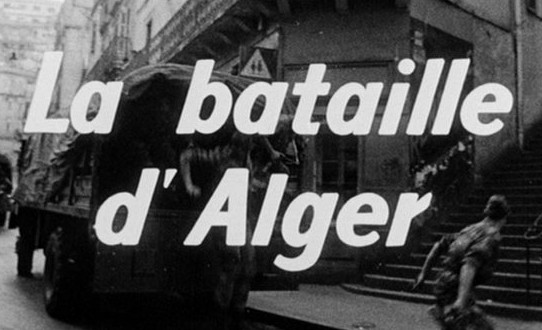
The Battle of Algiers


Pontecorvo's The Battle of Algiers is by no means an extraordinarily revolutionary film stylistically. Sure, it has a documentary-esque feel to express realism and puts the viewer in the action of the scene, but that had been done before with Battleship Potemkin (the one with the baby carriage falling down the stairs). And yes, the score was done by Ennio Morricone, a badass composer. But why is this movie part of the Criterion Collection? Why is there all this hubbub about a foreign, black-and-white, no-gore-no-sex, unprofessional-acting film? It's all about the timelessness, baby.


Peter Rainer of the New York Times Magazine writes:
"What reveals Pontecorvo as an artist, and not simply a propagandist of genius,
is the sorrow he tries to stifle but that comes flooding through anyway—the
sense that all sides in this conflict have lost their souls, and that all men
are carrion."

It is clear that Pontecorvo's purposes were not to side with either the French or the Algerians, but in doing so, he demonstrated that both sides were at fault, and both sides represent the innate self-preservation of man. The fact that this is a fundamental problem allows for many generations to see a piece of themselves in the film. For instance, it be applied as a reflection of the decline of European imperialism and how perhaps colonization and occupation may not be the best solution (cough cough ahem). It has been deemed an allegory for the Vietnam War. Both the Black Panthers AND the Pentagon have screened it for training purposes. The film truly does transcend the apparent differences in people and the eras they live in. And that, consequently, defines an unparalleled artistry.