Stud.Tuesday, March 25, 2008
KUROSAWAAA!
Stud.Sunday, March 23, 2008
Opening Night
This 38 second clip basically sums up Cassavetes for me. It is either the most rational, or most pretentious statement about movie goers I've heard, but it does offer insight into Cassavetes' style and approach to filmmaking. And it is VERY applicable to his movies, including 1977's Opening Night. Cassavetes smudges the line between life and art by presenting Myrtle, an aging stage actress played by Gena Rowlands feels alienated in her love life, as well as her professional life, especially after witnessing the death of one of her adoring fans who was hit by a car. The movie follows her through her coping with essentially her self-destruction. Nonetheless, it is very Cassavete-esque. Everything is recognizable as his style: the cast, camera movement and typical duration of scenes and shots are all demonstrative of Cassavetes. And the father independent film, at this point in my life, is tried and true. Perhaps in 1977, I would be amused by his innovation. I probably belong to the mass Cassavetes mentions in the above video. It's ok with me.
Tuesday, March 18, 2008
Alfred, you da bomb

Monday, March 17, 2008
The Killing of a Chinese Bookie
Thirty years ago, when The Killing of a Chinese Bookie was first released,
it bombed at the box office, much to Cassavetes’ disappointment. Critics
found it disorganized, self-indulgent, and unfathomable; audiences took
their word for it and stayed away. Today, the film seems a model of
narrative clarity and lucidity: either our eyes have caught up to
Cassavetes, or the reigning aesthetic has evolved steadily in the direction of his personal cinematic style. Now we are more accustomed to hanging out
and listening in on the comic banality of low-life small talk; to a semidocumentary, handheld camera, ambient-sound approach; to morally divided or not entirely sympathetic characters, dollops of “dead time,” and subversions of traditional genre expectations.
Thursday, February 14, 2008
Faces
Plot is hardly the focus in the movie. The main conflict dealt with the modern marriage in all of its dissatisfied glory. Sub-plots involving prostitutes and hate sex merely emphasize the disillusion of the American love life. Long scenes, albeit well-directed long scenes, are the stylistic focal point of the film, along with interesting camera work. Appropriate use of tracking shots and close-ups gave the movie a realist tone, as if the camera were simply an observer in a room. Interestingly enough, the movie's most memorable dialogue is no dialogue at all, but in fact laughter. Laughter and jokes reign dominant over most scenes. This is significant since many of the scenes are also realizations about a failed or tainted love life. Although the movie rivals any other in seemingly pointless and excessively long takes, the character development gets payed special attention.
Yes folks, the heroic prostitute is back and ready to rule the independent scene! Jeannie, played by Cassavete's wife Gena Rowland, juggles cardinal sin with true love when she meets Richard, a clearly older, married man seeking another outlet for love outside of his faithful wife. Although their relationship should be discredited, it is almost impossible not to feel sympathy for Jeannie. Obviously certain shots are manipulated in order for the audience to feel sympathy for the otherwise distasteful couple, but it reflects a skewed mentality birthed during this time. Sacred vows were no longer sacred as divorce gained popularity. Infidelity was not as taboo as before. Liberation was not limited to the mind, but also to the pants.
Regardless of the implications of the movie, one theme remained the most obvious: realizing and understanding unhappiness is the most satisfaction a person can get. No matter how much effort is put into "feeling better", there will always be discontent. It's what you do after you realize you're unhappiness that matters. Grim, yet realistic.
Tuesday, December 18, 2007
The Consequences of Fighting the Power
Take, for instance, his Love vs. Hate speech:
Let me tell you the story of "Right Hand, Left Hand." It's a tale of good and evil. Hate: It was with this hand that Cane iced his brother. Love: These five fingers, they go straight to the soul of man. The right hand: the hand of love. The story of life is this: Static. One hand is always fighting the other hand; and the left hand is kicking much ass. I mean, it looks like the right hand, Love, is finished. But, hold on, stop the presses, the right hand is coming back. Yeah, he got the left hand on the ropes, now, that's right. Ooh, it's the devastating right and Hate is hurt, he's down. Left-Hand Hate K.O.ed by Love.
Irony ensues. This has probably got to be my favorite soliloquy in a movie to date, but it also raises an interesting question. How can Radio Raheem preach love but express dislike and prejudice against different races? The fact that he fights racism with racism is too bizarre to even begin to justify. In order to fight the power (in hopes of restoring a balance) you have to fight. Consequently, more hatred is created and the effort becomes very cyclical and very unproductive.
Even Radio Raheem's death is an unfortunate result of the race crusade.
Total understanding will never exist (except for inside an idealist's mind), just like racism will always exist. However, there needs to be some kind of a reform and a general movement towards tolerance if we expect any hope for mankind.
On a lighter note, here's a Sesame Street remix of Do the Right Thing. Enjoy.
Wednesday, December 12, 2007
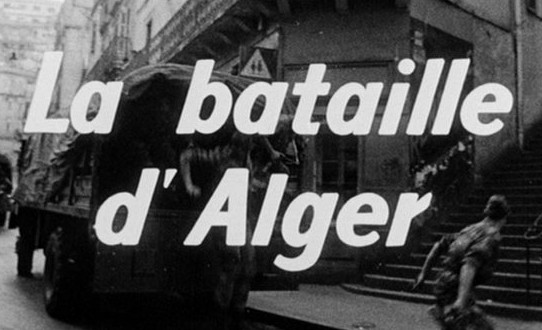
The Battle of Algiers

"What reveals Pontecorvo as an artist, and not simply a propagandist of genius,
is the sorrow he tries to stifle but that comes flooding through anyway—the
sense that all sides in this conflict have lost their souls, and that all men
are carrion."