Tuesday, December 18, 2007

The Consequences of Fighting the Power

Although all the characters in Do the Right Thing had their fair share of influence, Radio Raheem stands out the most in my opinion. He rocks his own neighborhood's t-shirt. He lets Public Enemy do the talking for him. And that boom box...when a ghetto blaster is the catalyst for a race riot, that tends to signify an unprecedented force. Yet, despite all his badass persona, Radio Raheem also represents hypocracy at its finest.
Take, for instance, his Love vs. Hate speech:
Let me tell you the story of "Right Hand, Left Hand." It's a tale of good and evil. Hate: It was with this hand that Cane iced his brother. Love: These five fingers, they go straight to the soul of man. The right hand: the hand of love. The story of life is this: Static. One hand is always fighting the other hand; and the left hand is kicking much ass. I mean, it looks like the right hand, Love, is finished. But, hold on, stop the presses, the right hand is coming back. Yeah, he got the left hand on the ropes, now, that's right. Ooh, it's the devastating right and Hate is hurt, he's down. Left-Hand Hate K.O.ed by Love.

Irony ensues. This has probably got to be my favorite soliloquy in a movie to date, but it also raises an interesting question. How can Radio Raheem preach love but express dislike and prejudice against different races? The fact that he fights racism with racism is too bizarre to even begin to justify. In order to fight the power (in hopes of restoring a balance) you have to fight. Consequently, more hatred is created and the effort becomes very cyclical and very unproductive.
Even Radio Raheem's death is an unfortunate result of the race crusade.
Total understanding will never exist (except for inside an idealist's mind), just like racism will always exist. However, there needs to be some kind of a reform and a general movement towards tolerance if we expect any hope for mankind.

On a lighter note, here's a Sesame Street remix of Do the Right Thing. Enjoy.

Wednesday, December 12, 2007

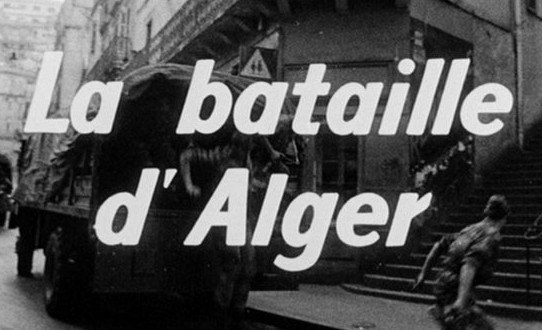
The Battle of Algiers


Pontecorvo's The Battle of Algiers is by no means an extraordinarily revolutionary film stylistically. Sure, it has a documentary-esque feel to express realism and puts the viewer in the action of the scene, but that had been done before with Battleship Potemkin (the one with the baby carriage falling down the stairs). And yes, the score was done by Ennio Morricone, a badass composer. But why is this movie part of the Criterion Collection? Why is there all this hubbub about a foreign, black-and-white, no-gore-no-sex, unprofessional-acting film? It's all about the timelessness, baby.


Peter Rainer of the New York Times Magazine writes:
"What reveals Pontecorvo as an artist, and not simply a propagandist of genius,
is the sorrow he tries to stifle but that comes flooding through anyway—the
sense that all sides in this conflict have lost their souls, and that all men
are carrion."

It is clear that Pontecorvo's purposes were not to side with either the French or the Algerians, but in doing so, he demonstrated that both sides were at fault, and both sides represent the innate self-preservation of man. The fact that this is a fundamental problem allows for many generations to see a piece of themselves in the film. For instance, it be applied as a reflection of the decline of European imperialism and how perhaps colonization and occupation may not be the best solution (cough cough ahem). It has been deemed an allegory for the Vietnam War. Both the Black Panthers AND the Pentagon have screened it for training purposes. The film truly does transcend the apparent differences in people and the eras they live in. And that, consequently, defines an unparalleled artistry.

Wednesday, November 28, 2007

In Need for a Holiday Pie/Neo-Noir Idea??

Look no further! For a limited time only, take home your very own Chinatown character Noah Cross PIE (chart)! Screenwriter Robert Towne really cooked up a doozy with this one, folks. I don't think there has ever been this complete of a villain since Jafar, and that's saying something. So while you gather around to celebrate [insert holiday here], take a moment to step back and appreciate the fact that even the most obnoxious and ornery of grandparents or second-uncles once removed do not even come NEARLY as close as Sir Cross did. Although it is unsettling to know that this human manifestation of cruel intentions was able to escape the clutches of the United States justice system, it is a comfort to know that he is probably going to get just as much (if not more) coming right back at him. Maybe not in this life, but definitely in his lives to come.
So please, this holiday season, deck the halls, bring us some figgy pudding and spin that dradle because someone, somewhere is wishing that their grandfather/dad wasn't such a creep.

Sunday, November 18, 2007

Witty Title Concerning Kiss Me Deadly


Kiss me deadly, schmish me deadly.

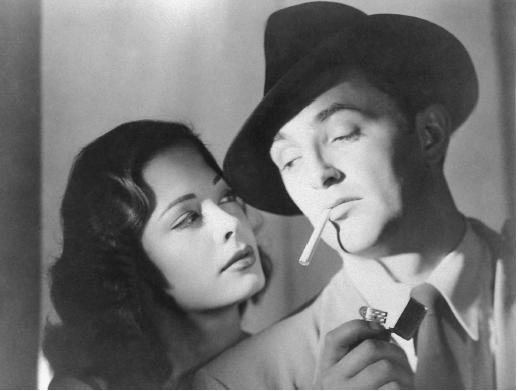
I'm sorry but if that movie was supposed to be an allegory to ANY aspect of human nature, I am sad for humans. Frankly, I find it hard to reach a deeper conclusion from the film. How about instead of interpreting every little potential allusion, metaphor, symbol, stylistic choice a movie offers, we just take it at face value. I'm sure the director did certain things to achieve a certain mood or theme, but what if we eliminate the director? What if we just watch the movie and let bygones be bygones? It would just be a really raw, violent movie with hints of nuclear waste, a heavily-panting woman and a machisimo protagonist with a machisimo first name. Mike Hammer? Come on, that name is just begging to be paired with a punch in the face or a smooch with a girl. He happens to be the most engaging part of the film; the only one I could remotely understand, even if it wasn't much. The plot probably was not supposed to be the strong point of the film, but a little continuity would not hurt. I still don't know what the conflict was supposed to be. I think the director just wanted to base a story off of an awkwardly moaning woman... even if it was based on a novel....ummm.... yeah.

I realize that if all movies (or any works of art in that case) were met with cynicism, their intended purposes would die upon contact with the scrutiny. I just felt like being a cynic tonight.
Who am I kidding? Hands down the greatest movie I've ever seen.

Tuesday, November 13, 2007

PelĂ­cula Negra


Film noir is the cinematographic expression of disillusionment during the post-WWII era.
Out of the Past (1947) arrived only two years after the war ended, adding to the list of film noirs that offered a sort of escapism to postwar America, the way Hemingway and Steinbeck did with novels. Both mediums depict alienated or dissatisfied characters in realistic settings, however film took the viewers to a different level by offering a visual interpretation to the masses. People could live vicariously through film noir characters. Women could embody the femme fatale persona to escape the routine of their life. Men could envision themselves as razor-sharp protagonists who fell victim to temptation. No matter what their reasoning, people turned to these films to explain the crookedness of their own worlds. The movies offered a cynical view of human nature, which was already being experienced during that time period. The differences was that film noir allowed the menace of man to exist without actually causing harm to anyone.
In a way, the Second World War era has become a kind of film noir in itself. History acts as the protagonist who is damned by fate. Its past (Holocaust, Nazism, total war etc.) tries to be forgotten but comes back to haunt the present (Israeli-Palestinian conflict, dictator uprisings across the globe etc.). The power-corrupt axis leaders represent the crooks, and the tangled and shifting alliances embody the manipulative, double-crossing femme fatale character. Whether that analogy is a stretch or not, the aftermath of such a devastating war was answered by authors and filmmakers alike to help cope with the dejected society of the post WWII world.

Tuesday, November 6, 2007

e.t.e.r.n.a.l.s.u.n.s.h.i.n.e.o.f.t.h.e.s.p.o.t.l.e.s.s.m.i.n.d.


Ignorance is bliss. A controversial cliché that happens to be completely applicable to the events in Eternal Sunshine of the Spotless Mind. The characters who seek memory erasure in the movie, Clementine, Joel and Mary, could be considered blissful until elements of their past lives are reintroduced indirectly. For Clementine it was Patrick stealing Joel's memories to try and recreate a bountiful relationship. The only way Joel could ever cope with the realization that Clementine erased him from his memory was to reciprocate the procedure and essentially become ignorant of their past relationship. For Mary, her shot at blissful ignorance was disrupted by her innate and inerasable connection to Dr. Mierzwiak. Even the title happens to side with the fact that ignorance, or an erased memory, can provide bliss, or in this case, sunshine. The titular reference comes from the Alexander Pope poem, "Eloisa to Abelard".
How happy is the blameless vestal's lot!/The world forgetting, by the world
forgot./Eternal sunshine of the spotless mind!
The lines address the potential, yet unattainable, concept of a cluelessly content society. This is disproved through the reconnections of Clementine and Joel. Despite the fact that they knew each other unbeknownst to the other, there was still tension and this sort of deja vu effect.The movie also alluded to existentialist Fredrich Nietzsche's Beyond Good and Evil when Mary quotes, "Blessed are the forgetful: for they get the better even of their blunders." This is very much in favor of how easy for forgetful have it than those who have to own up to their memories.
The movie supports the ideal nature of blissful ignorance but shows that there can be no pure instance of it in real life.

Wednesday, October 31, 2007

Diabetes! I ought to know better than to hire anyone with a disease.

Escaping convicts! Counterfeit money! Guns! Devious ex-husbands! Fast paced dialogue!
It's not the latest action flick of the season people. It's the 1940 screwball comedy His Girl Friday!
Although this movie could be labeled a love story, it is not your typical guy-meets-girl-guy-falls-in-love-with-girl-the-feeling-is-mutual-the-end. The concept of love in His Girl Friday is not necessarily a romantic love. Love is portrayed more as a discovery of passion, in the case of Hildy Johnson, a rediscovery of passion. Instead of falling victim to the archetypal woman's role during that time period, the circumstances of the film allowed her to realize her place in the press. Cary Grant's character, Walter Burns, could be considered romantically in love with Hildy, but it is almost as if he is in love with chasing her and winning her over. Walter's passion derives from wanting to always get his way, a self-sufficient kind of love.
But no matter how hard you try to break down a person's reasoning for pursuing a partner, it all leads back to the most fundamental biological necessity.
Procreation.
So go ahead. Throw around your fancy explanations of the romantic psyche and analyze behavior until you reach that inevitable cycling effect. All of those details merely accessorize the fact that humans, nay, all living things, have an innate responsibility to further their species.
So the next time you're sitting dutifully at another "love" movie, popcorn in hand, eyes fixated on the screen, ask yourself, what are these guys really trying to achieve here? To the untrained eye, their paths may not seem to lead to reproduction for biology's sake. But sooner or later, all stories' paths diverge at the central checkpoint that is copulation.